
You look in the mirror and notice a receding hairline. Maybe a bald spot is opening up on your crown. You try special shampoos. You rub oils into your scalp. Nothing works. That is usually when you start seeing the phrase online and wonder: what is a hair transplant?
It sounds intimidating. You might think it involves fake hair or intense hospital surgery. It doesn’t. If you live in Indore, you are in luck. The city has become a major hub for hair restoration in Central India. You can get world-class results right here.
Here is a straightforward overview of how it works, what it costs, and what you can expect.
The Basic Concept
A hair transplant is a straightforward medical procedure. A doctor takes healthy, living hair follicles from the back or sides of your head. They move these hairs to the bald or thinning areas in the front or crown.
This process uses your own real hair. Doctors do not use synthetic strands. They do not use hair from other people. The hair on the back of your head is genetically programmed to never fall out. When the doctor moves it to a bald spot, it keeps that trait. It stays permanent for the rest of your life.
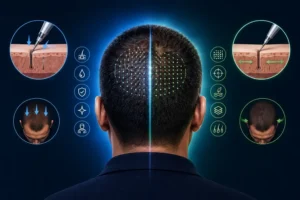
How It Works
Modern hair restoration is done while you are awake. You sit in a comfortable reclining chair. You can watch a movie, listen to music, or talk to the clinic team. The entire process follows three basic steps.
First, the medical team gently extracts healthy hair roots one by one from your donor area. Second, the doctor maps out your new hairline. They make tiny micro-openings in the bald areas. They match the natural angle and direction of your existing hair. Third, the team places the extracted roots into those openings.
The procedure is highly effective. Once the hair grows out completely, it looks entirely natural. Your regular barber will not even notice you had it done.
What Does It Cost in Indore?
Indore has excellent medical infrastructure. You do not need to travel to expensive metros like Mumbai or Delhi.
Clinics do not charge a flat fee for this procedure. The price depends on how much hair you have lost. Doctors measure this by counting individual hair grafts. A graft is a tiny natural cluster of one to four hairs.
Treatment Details
What are the different types of hair transplant surgery?
There are several different ways to perform hair transplant surgery, including:
- Grafting.
- Scalp reduction.
- Flap surgery.
- Tissue expansion.
How is grafting performed?
Hair grafting is the most common type of hair transplant surgery. A healthcare provider cuts tiny pieces of the scalp containing healthy hair. Sometimes they use a small, round punch to remove skin that contains about 10 to 15 hairs. People used to call these grafts “hair plugs.” Micro-grafts contain one to two hairs.
The procedure can take several hours. Most people stay awake during the surgery, but they receive medication to numb the scalp. You may need several procedures depending on how much hair your provider needs to move. Your scalp will need to heal for a few months between procedures.
How is scalp reduction performed?
Providers also call scalp reduction alopecia reduction. During this procedure, a surgeon removes a small area of bald skin from the scalp. They loosen nearby skin containing hair and pull it over the bald area. Then, they stitch it in place.
Scalp reduction is ideal for bald areas on the top and back of the head. These sections are usually surrounded by skin with hair. Sometimes providers use scalp reduction and hair implants together to achieve full coverage. Like grafting, scalp reduction usually only requires numbing medication on the scalp. This means you don’t need general anesthesia.
How is flap surgery performed?
Your surgeon may recommend flap surgery if you have large bald areas near the front of your scalp. Flap surgery occurs in several phases over a few weeks. The surgeon makes superficial cuts around three sides of donor site. The fourth side remains attached, maintaining its original blood supply. This technique helps the surgeon cut the flap and lift it over bald areas. Flap surgery requires general anesthesia.
The Results Take Time
You will not see a full head of hair immediately. This process requires patience.
During the first month, your newly planted hair shafts will actually fall out. Do not panic. This shedding is completely normal. The living root stays safe under your skin. New hair starts to sprout around the third month. You will see the final, thick result about 12 months after your procedure.
Frequently Asked Questions
Does it hurt?
The doctor uses a local numbing liquid on your scalp. You will feel a quick pinch during the initial numbing injections. After that, you will not feel pain during the rest of the day.
Can anyone get a hair transplant?
You need to have enough healthy hair on the back of your head to act as a donor source. If your donor area is completely bare, you might not be a good candidate. A quick check at a local clinic can confirm your status.
Next Steps
You do not need to learn complex medical jargon to fix your hair loss. The best approach is to get a professional opinion.
If you want to stop hiding your hairline under a cap, reach out to our team in Indore today. We can look at your scalp, answer your questions, and show you exactly what to expect.